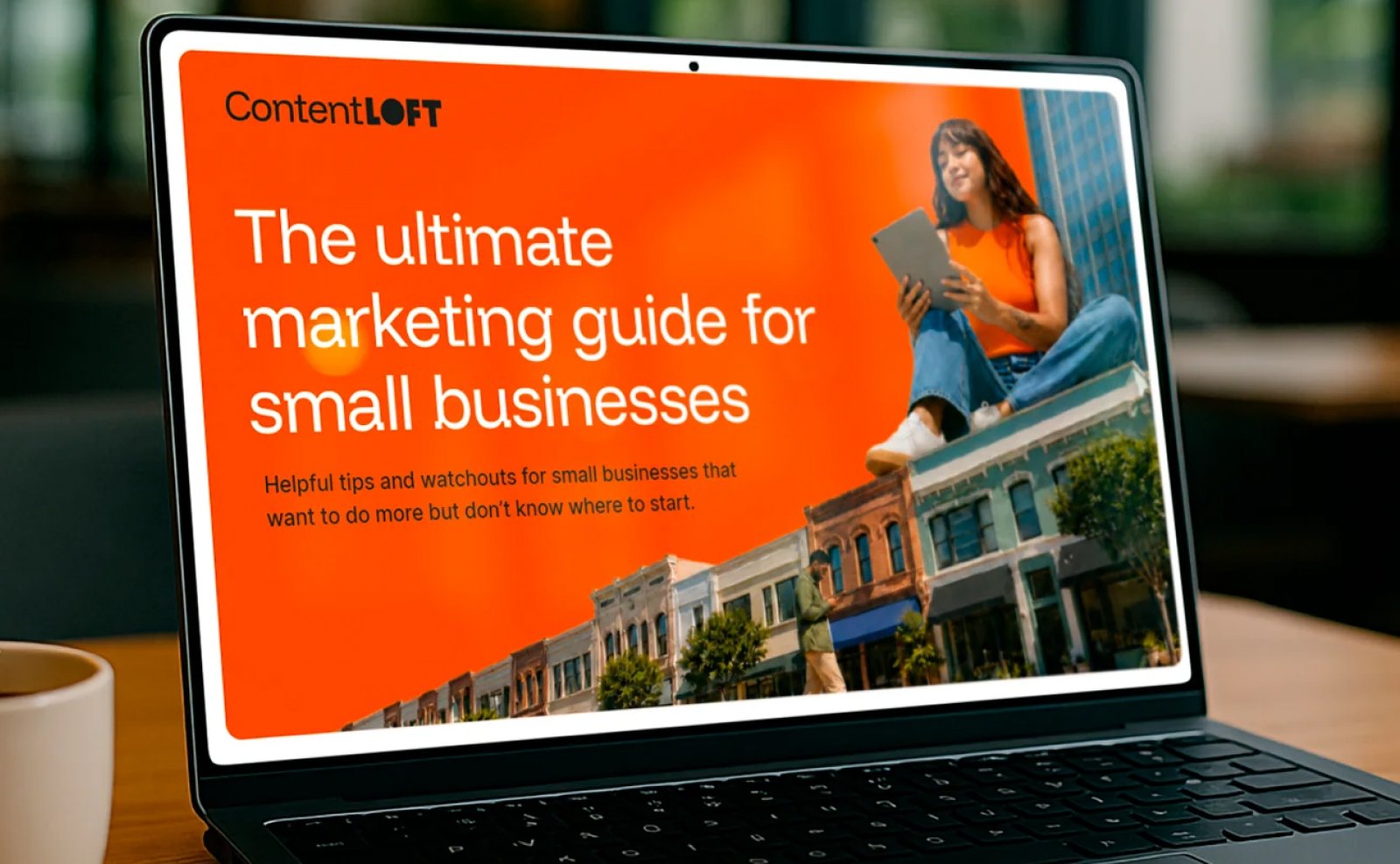
The ultimate marketing guide for small businesses
Small business marketing can feel unnecessarily complicated.
There are hundreds of platforms, countless tactics and a constant stream of new tools promising to make marketing quicker, easier or cheaper. For a small business owner already focused on customers, cash flow and day-to-day operations, it can be difficult to know where to start.
The answer is rarely to do more.
Effective small business marketing starts with getting a few fundamentals right: understand your customer, build a credible brand, create a website that supports sales, produce useful content and choose the channels most likely to reach your audience.
Once those foundations are in place, technology, automation and AI can make the work considerably easier.
What is small business marketing?
Small business marketing is the process of identifying the customers you want to reach and using the right messages, content and channels to attract, engage and convert them.
Unlike larger organisations, SMEs rarely have large marketing teams or substantial budgets. That makes prioritisation particularly important.
A practical small business marketing strategy should answer five basic questions:
- Who are we trying to reach?
- Why should they choose us?
- What information do they need before they buy?
- Where are they most likely to see our message?
- How will we know whether our marketing is working?
Your marketing activity should flow from those answers rather than from whichever new platform or tactic happens to be attracting attention.
The original ContentLoft guide makes the same point: limited budgets, time and resources mean small businesses need to concentrate on the areas that will have the greatest impact.
Start with a brand customers can understand
Branding is often treated as a visual exercise, but your logo and colour palette are only part of it.
Your brand also includes what you stand for, how you communicate and the reasons customers should choose you over an alternative.
Ask yourself:
- Is it immediately clear what we do?
- Does the business look credible?
- Does our messaging reflect what customers actually care about?
- Are our points of difference easy to understand?
- Does the brand feel appropriate for the customers we want to attract?
Strong branding creates consistency across everything that follows, from your website and social media presence to sales presentations and email marketing. The guide highlights both the visual and verbal sides of branding and the need for a clear point of difference.
Make your website work for the business
For most SMEs, the website is one of the most important pieces of marketing infrastructure.
It needs to do more than confirm that the company exists.
For an ecommerce business, the job is relatively obvious: make products easy to find, build confidence and remove friction from the buying process.
For a service business, the conversion may be different, but the principle is the same. The website should encourage a visitor to take the next step, whether that means requesting a quote, booking a consultation, making a call or completing an enquiry form.
A good small business website should therefore:
- clearly explain what the business does,
- speak directly to the intended customer,
- demonstrate expertise,
- provide proof through reviews, case studies or accreditations,
- make navigation straightforward, and
- give visitors a clear next action.
The guide makes a useful distinction between ecommerce sites and lead-generation websites, but both ultimately have the same commercial responsibility: convert interest into action.

Know exactly who you are marketing to
Trying to speak to everyone usually weakens the message.
A useful small business marketing strategy starts with an understanding of the customers most likely to buy from you.
For a consumer business, that might include age, location, buying habits, interests and typical spend.
For a B2B company, it may include company size, sector, job title, responsibility, budget and the problems the buyer is trying to solve.
Over time, these assumptions should be refined using real customer and marketing data.
Your ideal customer profile should influence:
- the language you use,
- the value propositions you lead with,
- the content you create,
- where you advertise,
- which social networks you prioritise, and
- the offers you promote.
The guide points out that only 35% of small businesses with 10 to 49 employees analyse business or customer data for insights, which leaves considerable room for SMEs that take a more evidence-led approach.
Create content that answers real customer questions
Content is where many SME marketing plans become unrealistic.
A small business does not necessarily need to produce white papers, videos, podcasts, reports and daily social posts.
It needs content that is useful to customers and realistic to produce.
Start with the questions your customers already ask:
- How much does your service cost?
- What is the difference between two options?
- How does your product work?
- What mistakes should customers avoid?
- What should someone consider before buying?
- What does the process look like?
These questions can become blogs, FAQs, videos, emails, social posts and website content.
That makes content useful for customers while also improving visibility through SEO and AEO.
The guide specifically recommends people-first, authoritative content and a publishing schedule that SMEs can genuinely maintain.
For search and AI discovery, this matters because well-structured content gives search engines and answer engines clear information they can understand and reference.

How does content support SEO and AEO?
For SEO, useful content gives your website more opportunities to appear when customers search for relevant topics.
For AEO, clear answers to specific questions make it easier for AI-driven search experiences to understand your expertise and extract useful information.
Practical steps include:
- answering important questions directly,
- using descriptive headings,
- creating dedicated FAQ sections,
- demonstrating genuine experience,
- using internal links between related topics,
- keeping information accurate and current, and
- avoiding generic content written solely to target keywords.
Choose marketing channels based on the customer, not fashion
Creating content is only part of the job.
It needs to reach people.
Most channels fall into three broad categories.
Owned media
These are channels your business controls, such as:
- your website,
- your email database,
- your blog, and
- your own social profiles.
Owned media usually takes longer to build but can continue delivering value without requiring you to pay for every impression or click.
Earned media
Earned media is visibility created by other people.
Examples include:
- reviews,
- referrals,
- PR coverage,
- recommendations,
- social shares, and
- customer advocacy.
It can be particularly valuable because someone other than your business is providing the endorsement.
Paid media
Paid media includes search advertising, paid social and other forms of digital advertising.
It can put your business in front of a specific audience very quickly, but the visibility generally stops when the budget stops.
The best channel mix depends on your ideal customer profile. The guide recommends resisting the temptation to spread marketing activity across every platform and instead concentrating on the channels most relevant to the audience.
For many SMEs, that might mean doing three things well rather than seven things badly.

Where should AI fit into small business marketing?
AI can be extremely useful for SMEs because it reduces the time required for routine marketing tasks.
Useful applications include:
- generating initial ideas,
- producing first drafts,
- repurposing existing content,
- analysing campaign information,
- summarising research,
- improving copy,
- researching topics, and
- automating repetitive processes.
But AI works best as support.
It does not inherently understand your customers, your internal knowledge or what makes your business genuinely different.
The guide therefore recommends maintaining a human in the loop, particularly where AI is producing customer-facing material.
This becomes especially important when inexpensive automated platforms promise to produce websites, advertisements or social content with very little human input.
Speed has value. So does low cost.
But businesses still need someone to assess whether the output is accurate, differentiated and appropriate for the brand.

Be cautious with cheap automated marketing
Low-cost marketing tools have created genuine opportunities for SMEs.
AI website builders can get a simple business online quickly. Automated design platforms can produce social content cheaply. Scheduling tools can save hours every month.
The problem comes when production is mistaken for strategy.
An automated website builder can create pages, but it does not necessarily understand:
- your competitive position,
- the best customer journey,
- why customers choose you,
- how your website should generate leads, or
- how the website fits into your wider marketing activity.
Similarly, a high-volume social content provider can produce 20 posts every month, but volume alone does not guarantee relevance, engagement or enquiries.
The guide highlights the trade-offs associated with productised social content and automated website creation, including additional charges, weak differentiation, limited human input, template-driven positioning and vendor lock-in.
The practical rule is simple: automate execution where it saves time, but retain human control over strategy, customer insight and quality.

Which small business marketing tools do you actually need?
The marketing technology market is enormous, so SMEs should resist buying software simply because it looks useful.
A basic technology stack could include:
Website measurement: Google Analytics, Google Search Console and, where needed, Google Tag Manager.
SEO and AEO research: SEMrush, Ahrefs and Google Ads Keyword Planner.
Website management: WordPress or Webflow.
Social scheduling: Buffer or Hootsuite.
CRM and automation: HubSpot or Pipedrive.
The guide recommends starting with the smallest technology stack capable of supporting the marketing plan, rather than building an expensive collection of overlapping tools.
Before adding any new platform, ask:
What specific problem will it solve?
Will we use it regularly?
Can we measure whether it improves results or saves meaningful time?
If the answer to those questions is unclear, you probably do not need it yet.

How to build a simple small business marketing strategy
For most SMEs, the process can be reduced to six steps:
- Define your target customer. Understand who is most likely to buy and why.
- Clarify your proposition. Make it easy to understand what you do and why you are different.
- Get your website working properly. Build confidence and make the next action obvious.
- Create useful content. Answer customer questions and demonstrate expertise.
- Choose a manageable mix of channels. Concentrate on where your customers actually spend time.
- Measure and improve. Use real results to decide what to continue, stop or change.
There is no requirement for a small business to execute everything at once.
A credible brand, good website, clear customer understanding and consistent content will usually provide a stronger base than a long list of disconnected marketing tactics.
Click here to download your copy of The ultimate marketing guide for small businesses
Final thoughts
Good small business marketing is not about being everywhere or adopting every new technology.
It is about making sensible choices.
Know who you want to reach. Give them a clear reason to choose you. Create useful information that helps them make a decision. Make it easy for them to act. Then measure what happens.
Technology and AI can make that process faster and more affordable, but they work best when they support a clear strategy.
For most SMEs, consistent progress across a small number of well-chosen activities will deliver far more value than constantly chasing the next marketing trend.
Frequently asked questions about small business marketing
What is the best marketing strategy for a small business?
The best small business marketing strategy starts with a defined target audience and concentrates budget on the channels most likely to reach that audience. For many SMEs, this includes a combination of a strong website, SEO, content, email, social media and carefully targeted paid advertising.
How much should a small business spend on marketing?
There is no universal figure. The right budget depends on growth targets, margins, market competition and how aggressively the business wants to acquire customers. Smaller businesses should focus on measurable activities and increase investment when they can demonstrate a return.
What marketing should a small business do first?
Start with your brand, customer profile and website. These provide the foundation for most other marketing activity. Once they are working properly, build visibility through content, SEO, social media, email or paid advertising depending on where your customers spend their time.
Is digital marketing worth it for small businesses?
Yes, particularly when activity is targeted and measured. Digital marketing allows SMEs to reach specific audiences, track customer behaviour and improve campaigns based on real data rather than assumptions.
Can a small business use AI for marketing?
Yes. AI can help with research, content drafting, repurposing, analysis and automation. However, customer-facing output should still be reviewed by someone who understands the business, customers and brand.
What are the most useful small business marketing tools?
A basic SME marketing stack often includes Google Analytics, Google Search Console, a website CMS such as WordPress or Webflow, SEO tools such as SEMrush or Ahrefs, social scheduling tools and a CRM such as HubSpot or Pipedrive.